
Hobbes’s Mechanical Phantasms and the Material Mind
Materialism › Philosophical
Phenomenal Appearance as Motion in the Body
Thomas Hobbes holds that whatever exists is body and whatever changes is motion, so sensation, imagination, memory, thought, and emotion are all motions in a living organism. Pressure from an external body travels inward to the brain and heart and provokes an outward counter-motion, or ‘endeavour’, and the felt appearance of color, sound, or pain (the ‘phantasm’) just is that motion. There is no immaterial soul and, for Hobbes, no explanatory gap.
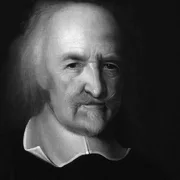 Thomas Hobbes
What consciousness is
A phantasm, the felt content of sensation, is identical with a reactive motion in the perceiver’s body. Appearance is real, wholly corporeal, and nothing over and above that motion.
Mind and body
Mind-body identity: mental states are motions in a body, so questions of union or interaction never arise. Hobbes calls ‘incorporeal substance’ a contradiction, two names with inconsistent meanings that together signify nothing.
Mechanism
Pressure and endeavour: an external body presses a sense organ, the pressure travels inward to the brain and heart, and the heart’s outward counter-pressure produces the phantasm, which persists for a while after the object is gone.
Core claims
- Sense is nothing but original fancy caused by the pressure of external things on the sense organs.
- Mirrors and echoes separate an appearance from its source, showing that sensible qualities are in the perceiver rather than the object.
- Inferring an incorporeal thinker from ‘I am thinking’ is like inferring an incorporeal walker from ‘I am walking’ (Hobbes’s objection to Descartes).
- Awareness requires difference: sensing the same thing always and not sensing at all come to the same.
Criticisms
If sense is reaction to pressure and all bodies react, all bodies should sense; Hobbes’s restriction to bodies with organs and memory looks contrived, and Sorell concludes some panpsychism is hard to rule out (Cavendish and Henry More pressed the same point). Leijenhorst reads phantasms as modes of the perceiver rather than identities with motion, a reading Duncan questions.
Implications
- Survival beyond death: No
- Since every mental state is a motion in a body and incorporeal substance is a contradiction, nothing of the mind continues once the body’s motions stop.
Related theories
- Descartes’s Substance Dualism (Critique)
- Place’s Empirical Identity and the Phenomenological Fallacy (Influence)
- Smart’s Topic-Neutral Identity (Influence)
- Locke’s Reflexive Consciousness and the Making of the Person (Contrast)
Sources
- Leviathan, Thomas Hobbes (1651)
- De Corpore, Thomas Hobbes (1655)
- Meditations on First Philosophy, with Objections and Replies, René Descartes (1641)
- The Wax and the Mechanical Mind: Reexamining Hobbes's Objections to Descartes's Meditations, M. P. Adams (2014)
- Debating Materialism: Cavendish, Hobbes, and More, S. Duncan (2012)
- Materialism from Hobbes to Locke, S. Duncan (2022)
- Hobbes and the Matter of Self-Consciousness, S. Frost (2005)
- The Mechanisation of Aristotelianism, C. Leijenhorst (2002)
- Hobbes and Descartes on the Relation between Language and Consciousness, G. M. Ross (1988)
- Hobbes, T. Sorell (1986)
Explore all theories on the Consciousness Atlas · Compare Hobbes’s Mechanical Phantasms and the Material Mind with other theories · Which theory of consciousness fits you?