
Śaṅkara's Self-Luminous Nondualism
Idealism
Consciousness as Self-Luminous, Nondual Brahman
Śaṅkara holds that pure, self-luminous consciousness is ultimate reality and that the true self (ātman) is numerically identical with Brahman. Consciousness reveals itself without needing a second awareness, so it is never an object, property, or product; the varied contents of experience belong to an insentient mind that consciousness illuminates. Ignorance makes this one consciousness appear as many embodied subjects, and liberation is the recognition that one has always been Brahman.
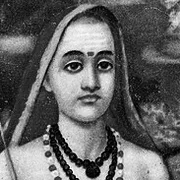 Śaṅkara
What consciousness is
Consciousness (cit) is self-luminous manifestation itself, the bare presence in which any content appears. It is the very nature (svarūpa) of the self and is identical with Brahman, the one nondual reality.
Mind and body
Mind is an insentient, subtle-material instrument (the internal organ, antaḥkaraṇa) whose states become experienced only through the consciousness that illuminates them. Body and mind are adjuncts that make the one consciousness appear limited and individual.
Mechanism
Self-luminosity (svaprakāśa) plus superimposition (adhyāsa). Consciousness manifests itself without a further awareness, and ignorance projects the properties of body and mind onto it, producing the ordinary ‘I’.
Core claims
- If awareness needed a second awareness to be manifest, an infinite regress would follow, so consciousness must be self-luminous.
- People report on waking that they slept well and knew nothing, which Śaṅkara takes to show that consciousness persisted without content in dreamless sleep.
- Statements like ‘I am thin’ or ‘I am unhappy’ show that the witnessing self is routinely confused with body and mind.
- Since sentience cannot originate in the insentient, consciousness must be the ontological primitive rather than a product of mind or matter.
Criticisms
Critics note that a memory-based deep-sleep argument cannot rule out after-the-fact reconstruction. How a beginningless ignorance relates to an awareness that is supposedly never modified is a long-standing difficulty. Vaidya argues that declaring consciousness fundamental does not solve the modern hard problem of why a particular subject experiences red rather than blue.
Implications
- AI consciousness: Uncertain
- Śaṅkara does not address machines. Since minds of any kind are insentient instruments that consciousness illuminates, the question becomes whether a machine could serve as such an adjunct, which the view leaves open.
- Survival beyond death: Yes
- Consciousness is never produced by body or mind and does not change, so the death of the body does not touch it; what ends is only a misidentification.
- Meaning and purpose: Cosmic/Ultimate
- The whole analysis aims at liberation (mokṣa), the recognition that one's self is Brahman, the ground of all reality.
- Virtual immortality: Unlikely
- Copying a mind would copy only an insentient instrument and its contents. The conscious self is already unborn and undying, so digital continuation adds nothing to it.
Related theories
- Sri Ramana’s Self as Pure Consciousness (Overlap)
- Thompson's Phenomenology: Waking, Dreaming, Sleeping, Pure Awareness (Overlap)
- Albahari's Perennial Idealism (Extension)
- Nāgārjuna’s Empty Consciousness: Experience Without Essence (Contrast)
Sources
- A Thousand Teachings: The Upadeśasāhasrī of Śaṅkara, Śaṅkara (trans. Sengaku Mayeda) (1992)
- Brahmasūtrabhāṣya (Adhyāsabhāṣya), Śaṅkara
- CIT: Consciousness, Bina Gupta (2003)
- Witness-Consciousness: Its Definition, Appearance and Reality, Miri Albahari (2009)
- Sleep as a State of Consciousness in Advaita Vedānta, Arvind Sharma (2004)
- Waking, Dreaming, Being, Evan Thompson (2015)
Explore all theories on the Consciousness Atlas · Compare Śaṅkara's Self-Luminous Nondualism with other theories · Which theory of consciousness fits you?