
Freud's Surface Consciousness and Irreducible Affect
Materialism › Homeostatic
Consciousness as the Fugitive Surface of an Unconscious Mind
Sigmund Freud treats consciousness as a thin, momentary surface of a mostly unconscious mental apparatus, shaped by repressed wishes, defenses and memories that never appear in awareness. Ideas can be fully unconscious, but affects cannot, because a feeling is by nature felt. This breaks the Cartesian equation of mind with consciousness while leaving felt quality as the one part of the psyche that resists the unconscious.
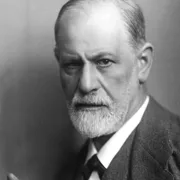 Sigmund Freud
What consciousness is
Consciousness is a sense organ for perceiving psychical qualities (the Perception-Consciousness system), registering outside stimuli and the inner pleasure–unpleasure series. ‘Conscious’ is a quality that particular contents may or may not acquire, not the essence of mind.
Mind and body
Freud saw the mind as an energy system rooted in the nervous system and expected biology eventually to reveal its mechanisms. His 1895 Project tried to describe psychical processes as quantitative states of material particles before he abandoned it.
Mechanism
Hypercathexis: an unconscious thing-presentation (a sensory memory trace) becomes capable of consciousness when given extra psychic energy through linkage with a word-presentation. Attention works as a supplementary cathexis directed by the conscious system.
Core claims
- Most of mental life is unconscious, and repression actively forces material out of awareness.
- Ideas can persist unconsciously with full causal force, while affects are constitutively felt.
- The constancy principle, inherited from Fechner and Helmholtz, makes the mind a proto-homeostatic system.
- Word-linkage gives contents access to report and thought, while affect supplies felt quality, a split resembling Block’s later access/phenomenal distinction.
Criticisms
Searle’s connection principle denies that a deep unconscious can hold intentional content never accessible to consciousness, and Sartre argued the divided psyche either needs a homuncular censor or collapses into bad faith. Solms, drawing on brainstem lesion evidence and Panksepp, argues the id is the source of consciousness, overturning Freud’s topography, though Schmidt and others contest that revision.
Implications
- AI consciousness: Unlikely
- Freud ties felt quality to affect arising from a bodily, regulatory energy economy, which a system without such drives would lack.
- Survival beyond death: No
- Since the mental apparatus is a natural, neurologically based system, nothing in the view lets consciousness outlast the body.
- Meaning and purpose: Humanistic only
- Freud locates motives and meaning in the individual organism’s drives and conflicts; unlike Jung, he sees no unconscious opening onto anything beyond the person.
- Virtual immortality: Unlikely
- Consciousness depends on a living organism’s affective, homeostatic economy, which copying ideas or memories would not reproduce.
Related theories
- Solms's Affect as the Hidden Spring of Consciousness (Extension)
- Jung's Collective Unconscious and Synchronicity (Contrast)
- Armstrong’s Higher-Order Perception Theory (Overlap)
- Sartre’s Pre-reflective Consciousness as For-Itself (Critique)
Sources
- Project for a Scientific Psychology, Sigmund Freud (1895)
- The Interpretation of Dreams, Sigmund Freud (1900)
- The Unconscious, Sigmund Freud (1915)
- Beyond the Pleasure Principle, Sigmund Freud (1920)
- The Ego and the Id, Sigmund Freud (1923)
- An Outline of Psycho-Analysis, Sigmund Freud (1940)
- The Conscious Id, Mark Solms (2013)
- The Hard Problem of Consciousness and the Free Energy Principle, Mark Solms (2019)
- Revision of Drive Theory, Mark Solms (2021)
- How and Why Consciousness Arises: Some Considerations from Physics and Physiology, Mark Solms and Karl Friston (2018)
- The ‘Id’ Knows More than the ‘Ego’ Admits, Mark Solms and Jaak Panksepp (2012)
- Metapsychological Consequences of the Conscious Brainstem: A Critique of the Conscious Id, M. Schmidt (2019)
- Consciousness Without Cortex: A Hydranencephaly Family Survey, B. Aleman and B. Merker (2014)
- On a Confusion about a Function of Consciousness, Ned Block (1995)
- The Rediscovery of the Mind, John R. Searle (1992)
- Being and Nothingness, Jean-Paul Sartre (1943)
- Psychoanalysis and Neuroscience: The Bridge Between Mind and Brain, F. Cieri and R. Esposito (2019)
Explore all theories on the Consciousness Atlas · Compare Freud's Surface Consciousness and Irreducible Affect with other theories · Which theory of consciousness fits you?