
Chomsky’s Language and Consciousness
Materialism › Language
Consciousness is a Mystery of Expanded Physics
This perspective analyzes consciousness through the lens of linguistic capacity, arguing that language (specifically universal grammar/deep structure) is innate and subconscious, thereby illuminating internal mental processes. Rather than proposing a specific mechanism for consciousness, Chomsky critiques the philosophical coherence of the 'hard problem,' arguing that it is a pseudo-problem because science lacks a definite, fixed conception of what 'body' or 'matter' truly is.
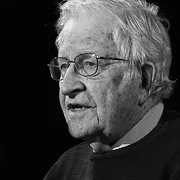 Noam Chomsky
What consciousness is
Consciousness is identified as a feature generated solely in the brain, adhering to a physicalist ontology. However, its specific identity cannot be formulated until science discovers the true, expanded nature of matter, suggesting consciousness will be assimilated into these newly discovered 'material' properties.
Mind and body
Mind is generated only in the brain (physicalist commitment). The traditional mind-body problem cannot be formulated coherently because the ontological status of the 'body' (matter) is unknown and undefined by current science, implying that the problem only resolves through an expanded, future physicalist identity.
Mechanism
The underlying innate linguistic deep structure, unique to humans, is the primary mental phenomenon discussed in his work, providing insight into internal processes critical for consciousness, even if the consciousness itself remains a scientific mystery for now.
Core claims
- Mind is generated only in the brain (materialist ontology).
- The mind-body problem cannot be formulated until the concept of 'body' is clarified by science.
- Linguistic capacity, based on innate 'deep structure,' revolutionized the study of internal mental phenomena.
Criticisms
Critics categorize Chomsky as a 'mysterian,' arguing that dismissing the problem as inherently unsolvable (or poorly formulated) is unproductive. Furthermore, if the problem lacks clear content, the resulting philosophical positions (including his own) also lack clear content.
Implications
- AI consciousness: Conditional
- Given the underlying physicalist commitment, AI consciousness must be possible in principle. If innate linguistic structures or deep computational capacity are key to consciousness, then advances in large language models would increase the likelihood of artificial realization.
- Survival beyond death: No
- The ontology is strictly materialist: the mind is generated solely in the brain. Substance dualism and the concept of a nonphysical soul are rejected, making post-mortem survival impossible.
- Meaning and purpose: Humanistic only
- As an aggressive critique formulated within a materialist framework, the theory aligns with the physicalist conclusion that ultimate cosmic meaning or purpose is irrationalized, leaving only human-created meaning.
- Virtual immortality: Possible
- If consciousness is wholly physical and reducible to brain processes (once 'physical' is redefined), the first-person mental self must eventually be uploadable, assuming technology can replicate the necessary physical relationships at the right level.
Related theories
- Challenge (Overlap)
- Eliminative/Illusionism (Compatible)
- Searle's Language and Consciousness (Contrasting)
Sources
- Language and Problems of Knowledge: the Managua Lectures (1987)
- New Horizons in the Study of Language and Mind (2020)
- Why Only Us: Language and Evolution, Robert Berwick and Noam Chomsky (2016)
- Chomsky on consciousness, Edward Feser (2022)
Explore all theories on the Consciousness Atlas · Compare Chomsky’s Language and Consciousness with other theories · Which theory of consciousness fits you?