
Searle’s Language and Consciousness
Materialism › Language
‘Language as Enhancer and Shaper of Consciousness’
Searle argues that language is crucial for human consciousness, serving to shape and enrich conscious experience . This relationship is seen as an evolutionary "boot-strapping effect" where pre-linguistic consciousness enabled language, which in turn elaborated the structure of consciousness .
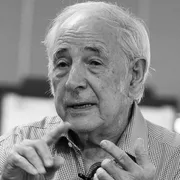 John Searle
What consciousness is
Consciousness is identified as real, subjective, qualitative states of awareness caused by, and realized in, biological neuronal processes in the brain . Language then functions as a mechanism to create and structure complex, higher-order conscious content .
Mind and body
Conscious states are realized in the brain as higher-level system features caused by lower-level brain processes . Mind is ontologically irreducible (subjective), but causally reducible to the brain . Language capabilities greatly expand the scope of the mental states realized .
Mechanism
The evolutionary "boot-strapping effect" where pre-linguistic consciousness gives rise to linguistic capacity, which then recursively enriches and complexifies consciousness through symbolic structures and inner syntax .
Core claims
- Language profoundly shapes and enriches the content and structure of human consciousness .
- Non-linguistic animals cannot have certain complex, symbolic conscious experiences due to a lack of inner syntax .
- Conscious states are ontologically irreducible but are causally determined by lower-level brain processes .
- Consciousness is crucial for the parts of language that are most important to us .
Criticisms
Criticized for the broader claims of Biological Naturalism, particularly maintaining ontological irreducibility while affirming causal reductionism . The distinction between simulation and biological causation is also highly disputed (e.g., the Chinese Room argument) .
Implications
- AI consciousness: Conditional
- Rejects that mere simulation (computation) can achieve human-like consciousness (Chinese Room) . However, if we built an artificial machine that replicated the necessary biological/causal processes of the brain, it could, in principle, be conscious . The centrality of language may make AI consciousness more likely if advanced language systems replicate the crucial inner syntax .
- Survival beyond death: No
- Consciousness is a biological feature caused by and realized in the brain . It ceases when the biological substrate dissolves .
- Meaning and purpose: Humanistic only
- As a Materialism theory, it cannot rationalize ultimate meaning or purpose cosmically . Consciousness, enhanced by language, allows humans to generate their own meaning, purpose, and complex agency .
- Virtual immortality: Conditional
- Virtual immortality (uploading the mental self) is attainable only if the duplication replicates the required biological/causal system, as simulation alone is rejected . If language is central to the deep essence of consciousness, the successful duplication of the linguistic/symbolic processes facilitates attainability .
Related theories
- Searle's Biological Naturalism (Basis)
- Chomsky's Language and Consciousness (Overlap)
- Koch's Consciousness does not Depend on Language (Critique)
- Jaynes's Breakdown of the Bicameral Mind (Overlap/Contrast)
Sources
- The Rediscovery of Mind, John Searle (1992)
- Consciousness and Language, John R. Searle (2002)
- Biological Naturalism, John R. Searle (2007)
- Language and consciousness, John Searle (Closer To Truth interview) (2014)
Explore all theories on the Consciousness Atlas · Compare Searle’s Language and Consciousness with other theories · Which theory of consciousness fits you?