The Consciousness Atlas is an interactive web app that visualizes more
than 450 theories of consciousness. It is based on Robert Lawrence
Kuhn's 2024 paper,
"A Landscape of Consciousness". The Atlas maps theories that address phenomenal consciousness - the
subjective feel of experience, such as the redness of red.
What the Atlas is
The Atlas is a visual reference built on Kuhn's taxonomy. It presents
the full set of theories at once so you can explore the field visually
and open any theory to read its entry, like an encyclopedia with
structured entries. Each theory entry shows a concise identity line,
conceptual ground, suggested mechanism, empirical notes, implications,
and sources.
Why this exists
Consciousness is studied across disciplines - neuroscience,
philosophy, and sometimes spiritual or anomalous-state research.
Kuhn's paper collects and organizes hundreds of theories along a
spectrum from most physical to least physical. The Atlas puts that
organization into a visual form so readers, students, and researchers
can quickly see how different positions relate and where each theory
sits on the spectrum.
How it works
Theories are grouped into eleven main categories, arranged from physical to nonphysical: Materialism, Non-Reductive Physicalism, Quantum and Dimensions, Information, Panpsychism, Neutral Monism, Dualism, Idealism, Phenomenology, Anomalous States, and Challenge Theories. The app shows the whole map at once. Click any theory to read its structured entry, which includes references to canonical sources and named thinkers.
Who it is for
- Students learning philosophy of mind and cognitive science
-
Researchers and lecturers looking for an at-a-glance comparative
resource
-
Journalists and writers who need a quick reference to the range of
positions
-
Curious readers who want a clear view of what people mean when they
talk about consciousness
What the Atlas does not do
The Atlas does not endorse or rank theories. It is a visualization and
reference based on Kuhn's taxonomy - collect and present, not judge.
It does not attempt to settle the hard problem of consciousness. It is
a tool for exploration and comparison.
A note from Kuhn
Kuhn explicitly states the project's purpose: "collect and categorize,
not assess and adjudicate." The Consciousness Atlas follows that
approach. The data and structure are derived from Kuhn's paper;
feedback and suggested corrections are welcome, but the app is a
visualization layer on top of Kuhn's work.
Kuhn was not involved in the design or content of the Consciousness
Atlas, other than his original paper, 'A Landscape of Consciousness,'
which is the sole source.
FAQ
What is phenomenal consciousness?
Phenomenal consciousness refers to subjective experience - the
qualitative feel of being aware, like the taste of coffee or the
redness of red.
How many theories does the Atlas include?
The Atlas visualizes more than 450 individual theories, grouped into eleven broad categories.
Does the Atlas show which theory is true?
No. The Atlas presents theories neutrally. It is a map, not an
argument for any single position.
Is the Atlas academic?
The Atlas is based on an academic source - Robert Kuhn's 2024 paper,
"A Landscape of Consciousness" - and links to canonical sources
where available.
Summary
The Consciousness Atlas is a straightforward visualization tool: it
presents Kuhn's taxonomy as a single, explorable map and lets users
open individual theory entries to read structured, referenced
summaries. It is designed to make this complex field easier to survey
and to serve as a practical reference.
Teilhard de Chardin’s Evolving Consciousness
Monism › Evolving Consciousness
Consciousness as the Withinness of Matter
This theory frames consciousness axially within a grand cosmic system defined by continuing complexification. It posits that consciousness and matter are complementary aspects of the same cosmic substance, leading toward a unified convergence and a hyper-personalized organism, referred to as Omega.
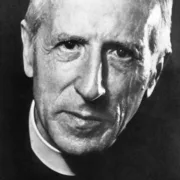 Pierre Teilhard de Chardin
 Ilia Delio
What consciousness is
Consciousness is identified as the 'withinness' or 'radial energy' of matter, complementing its 'withoutness' or 'tangential energy' (physical attraction), existing as two inseparable aspects of the same cosmic stuff.
Mind and body
Mind and matter are complementary aspects of a single cosmic stuff; neither is reducible to the other, yet they cannot function without each other.
Mechanism
The law of complexity-consciousness, which dictates that the greater the exterior physical complexity, the greater the interior level of consciousness, driving evolutionary progress.
Core claims
- Evolution is fundamentally the rise of consciousness, following the law of complexity-consciousness.
- Matter possesses an inner aspect ('withinness' or radial energy) which rises with physical complexity.
- The process converges toward Omega (God), the unifying power in evolution.
Criticisms
As a comprehensive metaphysical framework, it may be criticized by materialists for relying on theological concepts and for postulating non-physical aspects ('withinness' or 'radial energy') that lack empirical access or falsification.
Implications
- AI consciousness: Likely
- If the law of complexity-consciousness holds universally, artificial systems achieving sufficient complexity and interconnectedness (like the 'field of global mind' evoked by computers) would necessarily experience consciousness.
- Survival beyond death: Yes
- The universe is an irreversible personalizing system converging toward Omega (God), implying that individual consciousness or its hyper-personalized form persists and is absorbed into the cosmic whole.
- Meaning and purpose: Cosmic/Ultimate
- The universe is purposeful, driven toward the ultimate goal of maximization of thought (self-reflective consciousness) and convergence with Omega (Theogenesis).
- Virtual immortality: Possible
- Digital systems might facilitate the 'field of global mind' (noosphere) contributing to the cosmic convergence, allowing for a form of transcendent, non-biological continuation.
Related theories
Sources
- The Phenomenon of Man (1959)
- The Future of Man (1964)
Explore all theories on the Consciousness Atlas · Compare Teilhard de Chardin’s Evolving Consciousness with other theories · Which theory of consciousness fits you?
