
Blums’ Conscious Turing Machine
Materialism › Computational
Consciousness as Broadcast and Inspection of World-Model Chunks
Lenore, Manuel, and Avrim Blum hold that consciousness, both access and phenomenal, is computational and can be captured in a formal machine model, the Conscious Turing Machine (CTM). In CTM, unconscious processors compete to place a chunk of information on a one-item ‘stage’ that is broadcast to all of them; the machine feels something when every processor inspects that broadcast against its self-built Model of the World, which it takes to be the world itself.
 Lenore Blum
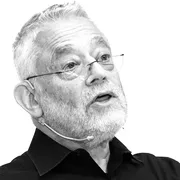 Manuel Blum
 Avrim Blum
What consciousness is
Consciousness is a computational process. Conscious attention is the simultaneous reception of a broadcast chunk by all processors; conscious awareness is all processors simultaneously inspecting that chunk, whose meaning is grounded in the machine’s Model of the World.
Mind and body
Mind is the organization of computation, independent of substrate. CTM deliberately makes no claim about which brain areas implement which functions, so the same model can apply to brains and machines.
Mechanism
A probabilistic winner-take-all tournament up a binary tree, where each chunk’s chance of winning equals its weight divided by the total weight of all entries. The winner is broadcast to every processor, and conscious awareness occurs when all processors inspect it in the same tick.
Core claims
- A theorem shows that a chunk’s chance of winning is its weight divided by the total weight of all entries, independent of where processors sit in the tree.
- CTM reproduces inattentional blindness, change blindness, and a Libet-like delay between a chunk entering the competition and its broadcast.
- Mislabeled sketches in the Model of the World produce analogues of phantom limb syndrome, body integrity disorder, and paranoia.
- CTM aligns at a high level with global workspace theory, attention schema theory, predictive processing, embodied cognition, and integrated information theory.
- CTM predicts that a central executive is unnecessary for consciousness, and so that the brain has none.
Criticisms
Critics question whether formal definitions and symbol processing can capture felt experience. Subjective experience enters through Axiom A, so the account of feeling rests on an assumption. Anil Seth and Nick Humphrey, whose views overlap with CTM, hold that consciousness requires a living organism, which the Blums reject.
Implications
- AI consciousness: Yes
- The Blums argue CTM is buildable and that it makes AI consciousness plausible, even inevitable.
- Survival beyond death: No
- Since consciousness here is a computational process with a finite lifespan, it ends when the machine or brain stops running.
- Meaning and purpose: Humanistic only
- The theory explains consciousness as computation and posits no cosmic purpose.
- Virtual immortality: Possible
- If consciousness is substrate-independent computation, reproducing the same processes in another machine would follow from the view, though the Blums do not address this.
Related theories
- Baars's and Dehaene's Global Workspace Theory (Foundation)
- Graziano's Attention Schema Theory (Overlap)
- Dennett's Multiple Drafts Model (Compatible)
- Seth's "Beast Machine" Theory (Contrast)
Sources
- Lenore, Manuel, and Avrim Blum’s Conscious Turing Machine (Landscape of Consciousness), Lenore Blum, Manuel Blum, Avrim Blum (2022)
Explore all theories on the Consciousness Atlas · Compare Blums’ Conscious Turing Machine with other theories · Which theory of consciousness fits you?